
What are public meetings even for?
- Apr 26
- 3 min read
Over the past few years, I’ve developed an unhealthy understanding of how meetings work (or, sometimes, don’t). Over at the Economic Development Commission (EDC) the grasp on Robert’s Rules of Order is tenuous at best. Audience members often have to remind them of what is and is not allowed (unless something has changed since I decided to go to kickboxing class instead of the EDC).
The Planning & Zoning Commission is probably the best example to use to explain the difference in meetings because they so often have public hearings. A regular meeting is a time to get business done according to the agenda that has been published in advance. If it’s a regular meeting, there is some leeway to add items to the agenda. If it’s a Special Meeting, you’re not supposed to stray. At the PZC there is no Public Comment session, but given the relatively small audience they are usually willing to entertain questions from anyone who is willing to show up.
At a Public Hearing—often needed for regulatory reasons—things work differently. These are designed for the public to be able to give their opinions on the matter at hand (read this article about a recent public hearing). They are advertised in the Journal Inquirer and neighboring property owners are notified. Depending on the topic, they can go on for a long time, but during a public hearing, PZC Chair Dave Palmberg instructs commenters to address all comments to him (part of Roberts Rules of Order). Once the public hearing closes, the commission convenes a regular meeting to actually make a decision. At that point, the public is no longer allowed to comment.
There are all sorts of other kinds of meetings, such as Informational Meetings. We’ve had a lot of those recently, such as the recent “Informational Meeting--Sharing Transfer Station with Tolland.” Every once in a while, First Selectman Bill Morrison will call it a hearing by accident, and his Executive Assistant Beth Dadalt has to correct him. Why? Because what you call a meeting matters, at least to the government, and hearings and meetings are different.
And then there are Town Meetings, an entirely different animal. This is where the people get to vote on specific items. We saw this firsthand when Stafford decided to change from electing to appointing its clerk and tax collector. Normally a handful of people are present, and they vote on something routine, like sending a budget to referendum or changing an ordinance.
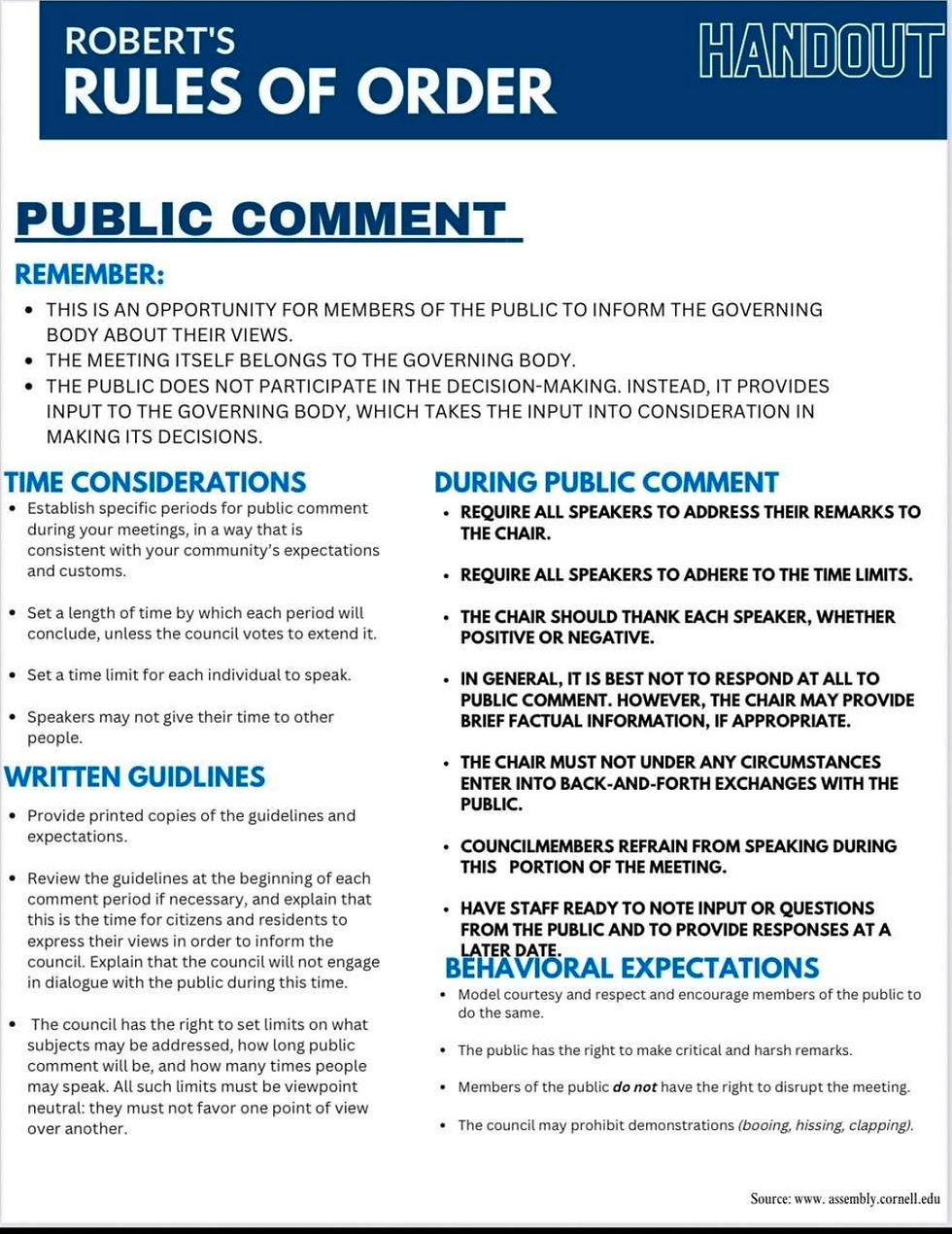
For a long time, neither the Board of Finance (BOF) nor the Board of Selectmen (BOS) had official public comment sections of their meetings. In fact, the Board of Education was the only meeting in town I know of that really had a formal public comment period. They are usually very good about not responding to comment (as Robert’s Rules of Order suggests it should be. I don’t stand up and ask questions during public comment because that’s not what they’re for. It’s right there in the name: comment. If I have a question I approach the various board or commission members after the meeting is over.
But since the BOF and BOS instituted a public comment session, they’ve had a hard time keeping these under control. Part of that is their own fault. People have endless questions and the boards sometimes try to answer. But one question usually just begets another. And frankly, more often than not, I could answer most of the questions based on what just transpired in the meeting. Not to brag but my third grade teacher did call me “diligent” and anyone who has ever had to play a trivia-based game with me knows I retain an alarming amount of (mostly useless) information.
I've spent 20+ years taking in and distilling information for other people, and I too miss things from time to time, or misunderstand them, which is why I hang around to clarify when necessary. Still, I often find myself thinking, “Weren’t you listening?” Did I mention that a high school teacher once told me I have a superiority complex? I tend to think that’s what insecure men say to smart girls with good self-esteem, but, then again, I may have a superiority complex. I digress…
This is all to say, sometimes the questions have already been answered, and what's more useful is for people to weigh in with feedback, just like Robert intended.


